Designing AI that agents will actually use
The insurance industry is investing billions in AI, yet despite the investment and the transformative potential, adoption among agents and brokers remains uneven. In the race to embrace AI, much of the conversation has centered on the technology itself rather than the people expected to use it.
We wanted to dig deeper into the day-to-day realities of insurance work to understand where AI is genuinely creating value, where it isn’t, and what it would take to design AI that agents and brokers would actually choose to use.
“I mean, the problem I have with AI? It’s not solving a problem. It’s just the shiny thing that everybody needs to say they have.”
Insurance Agent, C&A Research Participant
From frontline research to product strategy
To answer those questions, we interviewed 16 agents and brokers across 13 states representing independent agencies, national brokerages, and financial advisory firms. Rather than focusing on what AI could do, we focused on where agents were already finding value, where AI was falling short, and what agents actually needed: fewer disconnected systems, less repetitive work, more transparency, and tools that supported—not replaced—their expertise.
Those insights became the foundation for Adjacent, a future-state product concept designed around real insurance workflows.
One AI experience across every insurance system
One takeaway from our research was loud and clear: insurance professionals don’t need another application to manage, they need the systems they already use to work together.
This shaped how we approached the design. Rather than building a new application, we considered how we might design a layer that sits inside the tools agents already have open—something that could pull context from those systems and surface it right where the work is happening.
To get there, we mapped out where that data lives today and where it needs to show up. We matched each source system to the moments in an agent’s workflow it should inform.
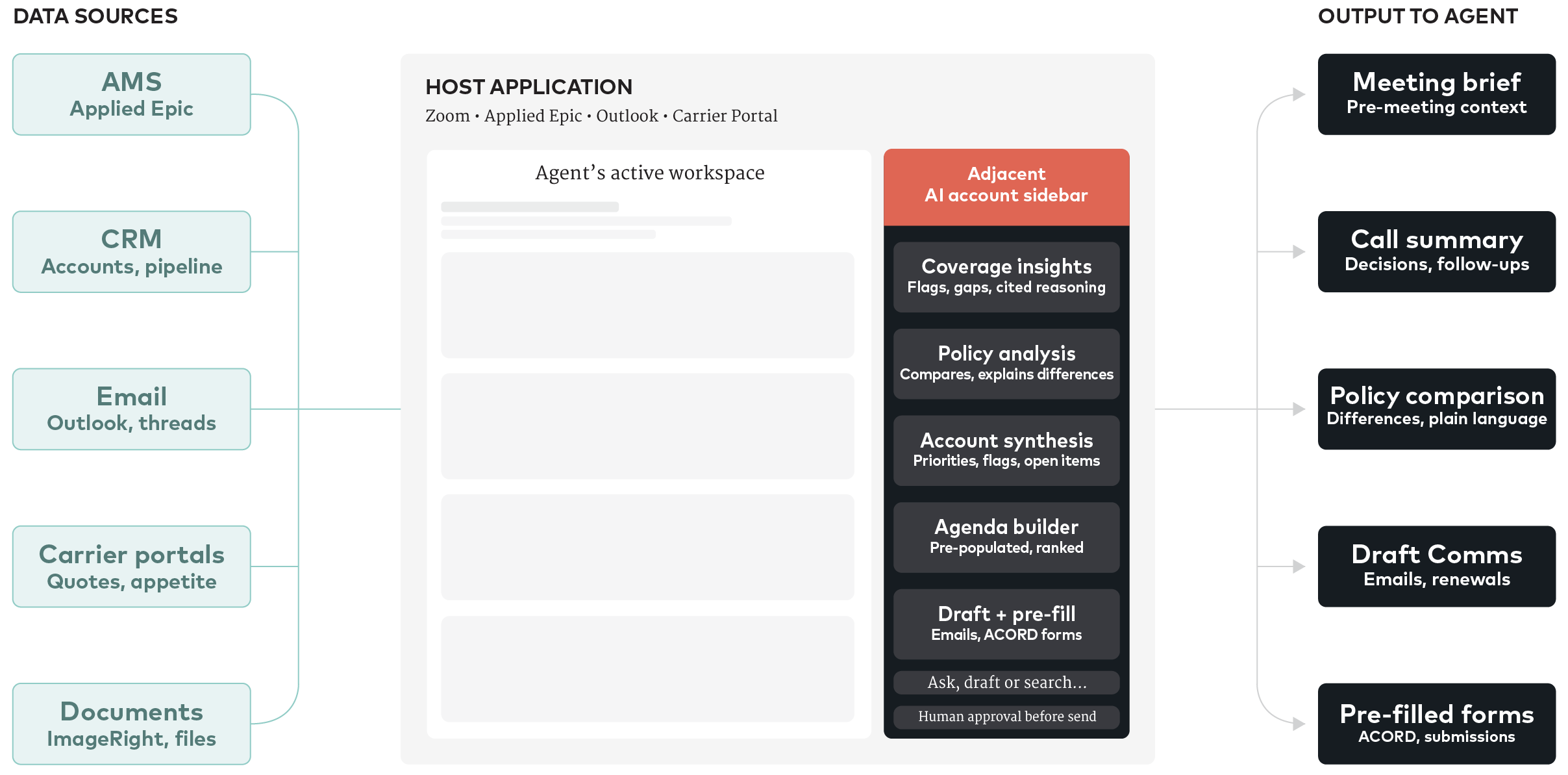
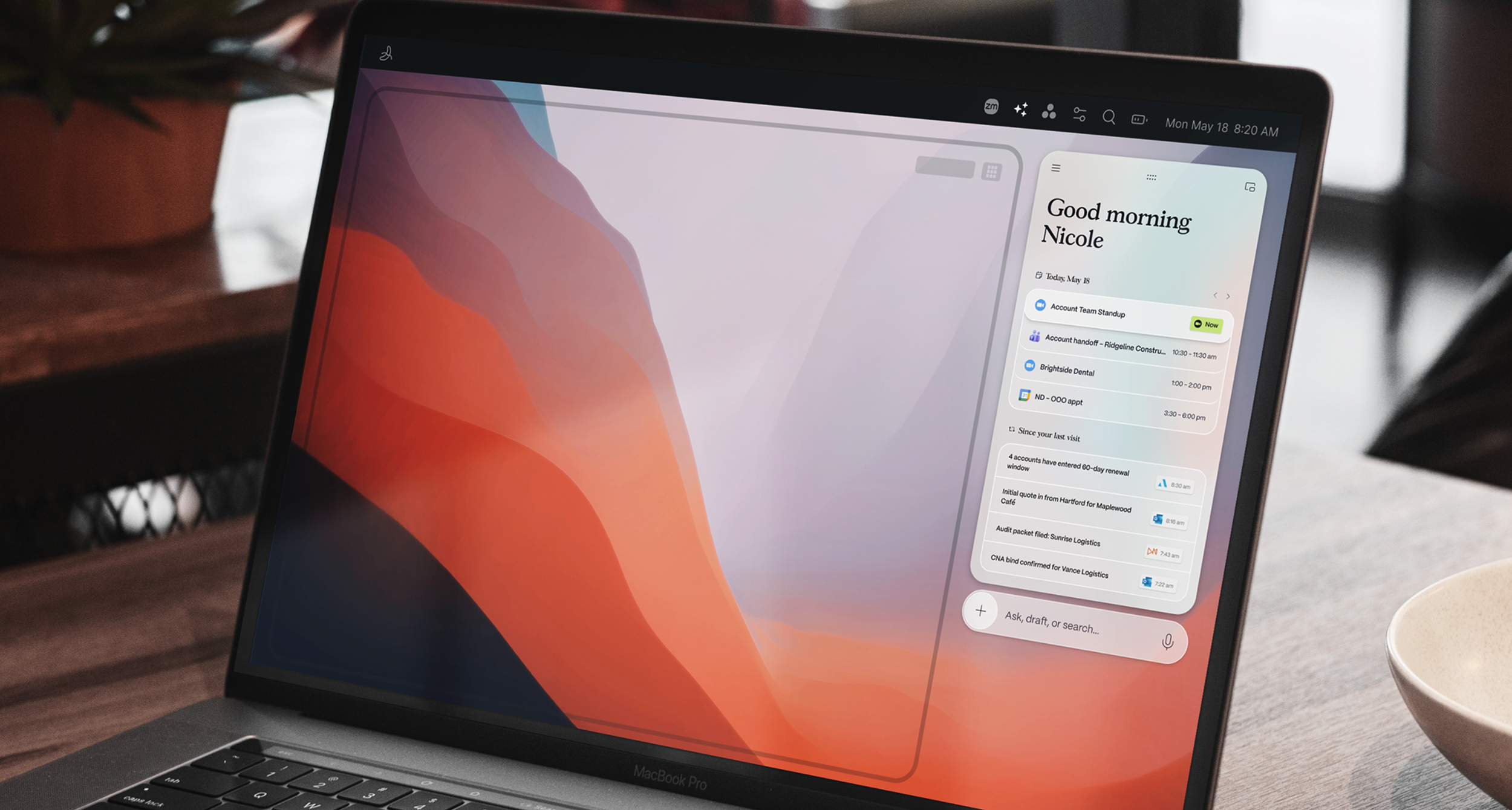
Adjacent UI is persistent, living alongside any app, without ever replacing it.
Report
As the insurance industry continues to pour money and resources into AI, the adoption gap among agents and brokers persists. In this report, we share what we heard from 16 agents and brokers on the frontlines about how they are using AI, how their organizations are (and are not) supporting them, and what problems they want AI to solve. Finally, we present a research-based design vision for AI that actually works for agents and brokers.
Meet Adjacent
Designed as a persistent AI layer that works alongside existing applications rather than replacing them, Adjacent connects information across agency management systems, CRMs, carrier portals, email, and documents to deliver timely, contextual guidance wherever work is happening.
Instead of searching across multiple systems, agents receive synthesized insights that help them prepare for meetings, compare policies, draft communications, and complete routine work faster—all without leaving their existing workflow.
Design Principles for Agent-Broker AI Adoption
If AI adoption is ultimately a design challenge—not just a technology challenge—then the question becomes: what should we design for? Our research and concept work pointed to five principles for creating AI that fits the realities of insurance work and earns a place in agents’ daily workflows.
Design for integration, not addition
Agents are already drowning in 7–10 disconnected systems. AI that adds another tab to manage will be abandoned. AI acts as connective tissue across the existing ecosystem will be adopted.
“Instead of having 15 different systems that don’t communicate, AI should be able to connect into those systems — to tie everything together.”
Melissa, Account Executive at a Benefits Brokerage
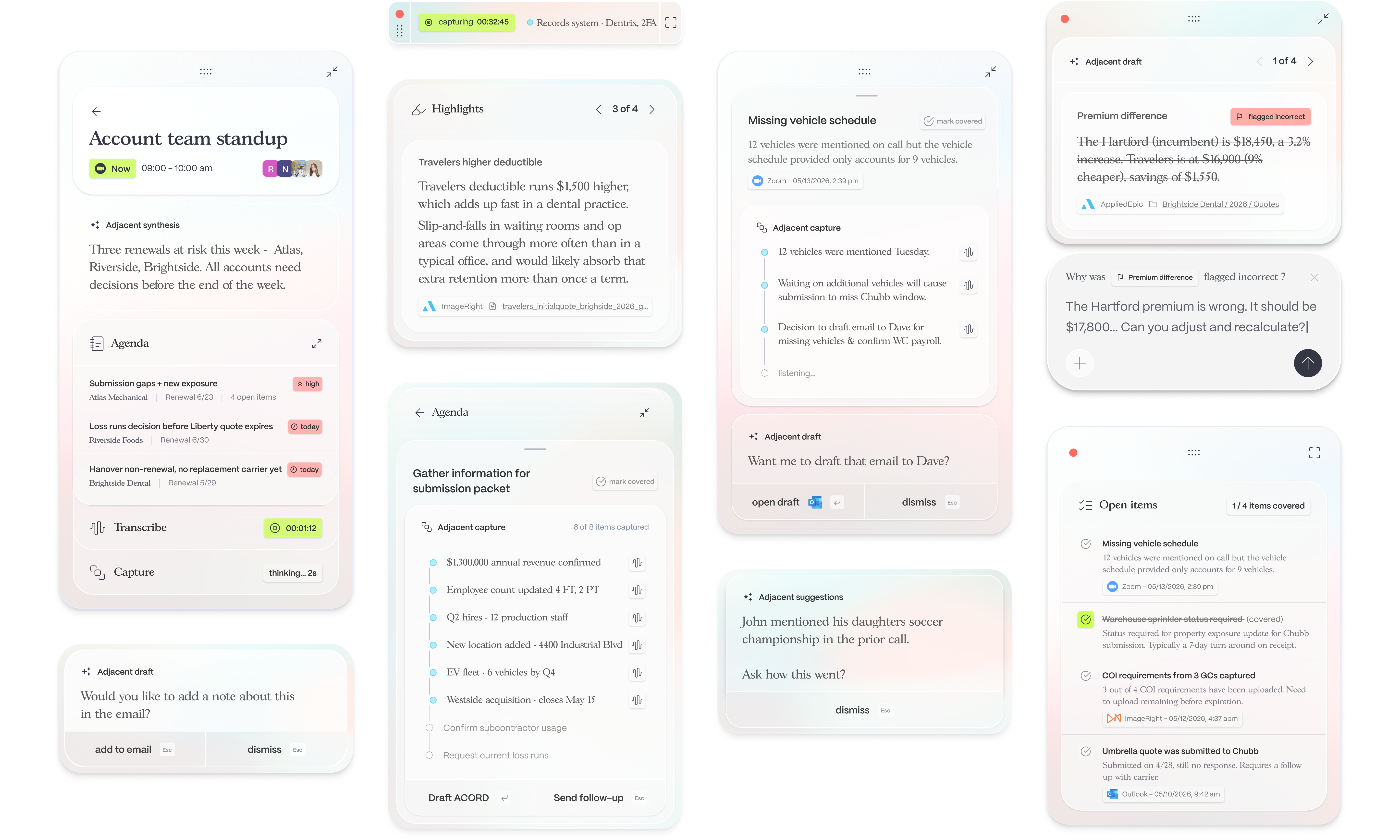
Adjacent follows the agent wherever the work is happening—Zoom, Outlook, Applied Epic, etc.
Design for “trust but verify”
Agents with domain expertise are the most effective AI users precisely because they know when to question the output. AI that earns trust is AI that shows its work.
“Like everything else, it’s trust but verify. You need to be able to look at an AI output and know something’s not quite right.”
Elizabeth, Account executive with 31 years of experience
Adjacent agents verify, correct, and train the model as they work
Design to keep humans at the forefront
Agents’ core value is the trusted relationship — and the biggest fear is AI that pulls them out of it. The best AI recedes into the background so the human can stay front and center.
“I’d like to think AI is going to give me more time to actually take care of my clients — managing their accounts, being present — instead of spending all my time on service work.”
Jeffrey, Independent Agent
During client calls, agents can collapse the panel entirely — Adjacent keeps capturing in the background while the agent focuses on the client.
Design for the workflow, not the moment
Isolated AI features don’t solve the problem. Agents need support that follows them through the arc of a task — before, during, and after — not just at the point of a specific question.
“Unless I put a task to call the client in three weeks, it’s not going to get done. But if AI could see the interactions and nudge me, say, oh hey maybe you should call this person because you haven’t reached out in a while— that would be amazing. Like oh my God, I can’t believe I haven’t called them. Really? It’s been that long? I forgot. I’m on it.”
Sarah, Financial Advisor
Adjacent turns what’s decided in the meeting into draft emails, follow-ups, and next steps.
Design for knowledge transfer, not just efficiency
With half the insurance workforce retiring in the next decade, AI’s most important long-term job isn’t saving time — it’s making institutional knowledge accessible to the next generation.
“There’s so much knowledge leaving our industry with people retiring. AI can help fill some of those gaps by making information more accessible and helping newer employees get up to speed faster.”
Brian, Agency Owner and Principal
Adjacent cites every insight and suggestion to its source, so agents can trust AND verify AI output.
“ Jay, Financial Advisor and Insurance Agent
“Yeah, this is so user-friendly and in-depth. I like that it's proactive, forward thinking… it just has such a modern, intuitive feel to it. I'm very intrigued – it would be something I'd be open to implementing in my practice."
“ Kathy, Account Executive
“I really like how Adjacent pulls everything together — the total premium, the deductible, the highlights of the coverages. This is what I was trying to do with Excel spreadsheets, but this is way more user-friendly, and way less work. For everyday people, this would be super nice to have."
“ Jessica, Commercial Account Manager
“That would be awesome if you could go into each client and have a snapshot of all the things that were recently done in each system — emails, Epic, ImageRight. It would definitely help in producer meetings to just pull up the client — I'm sure it would jog a lot of things that have been forgotten.