Featuring an interview with our Director of UX, Michael Piastro
Design systems have recently become something of a buzzword in insurance. Attend any insurance conference, and you’ll hear them referenced as the solution to the inconsistency, inefficiencies, and fragmented digital experiences that plague insurance.
As user experience designers who work exclusively in insurance, we’ve seen the growing demand firsthand. More and more carriers are coming to us with the same request: “We need a design system.”
And we agree. These companies do need design systems, desperately so.
Unlike the digital product companies that have emerged over the last few decades, insurance organizations weren’t built to compete on user experience. They were built to do things like manage risk and maintain compliance (things, for the record, they do extraordinarily well). Experience simply wasn’t the battleground.
Contrast that to companies like Uber or Lyft. Beyond offering a better price or even a better “product” so to speak, they compete by offering a more seamless end-to-end journey, with better usability, clearer pricing, stronger features, and greater reliability.
Insurance hasn’t traditionally worked that way. Customers bought coverage because they had to, and chose carriers based on price, availability, or whoever their broker recommended.
But the market is changing.
As insurers face shifting customer expectations, rising retention pressures, and increasing competition across the industry, 2026 may be the year when customer experience truly takes center stage. According to Forrester’s 2026 Insurance Industry Outlook, customer experience will become a competitive battleground for insurers.
And that’s where design systems can really make an impact.
Design systems—foundational to nearly every digital consumer product you can name—are how organizations scale good user experience. They make it possible to deliver consistency, speed, and quality across digital experiences without exposing customers to all the complexity happening behind the scenes.
Needing a design system isn’t the same thing as being ready for one
So yes, insurance companies need design systems. But in our experience, building a design system is only the first step.
We can (and do!) help insurance companies design and deliver thoughtful, well-documented design systems. But what determines whether a design system actually creates value is what comes after we hand it off to our clients: whether teams can adopt it, trust it, and use it as part of their everyday work.
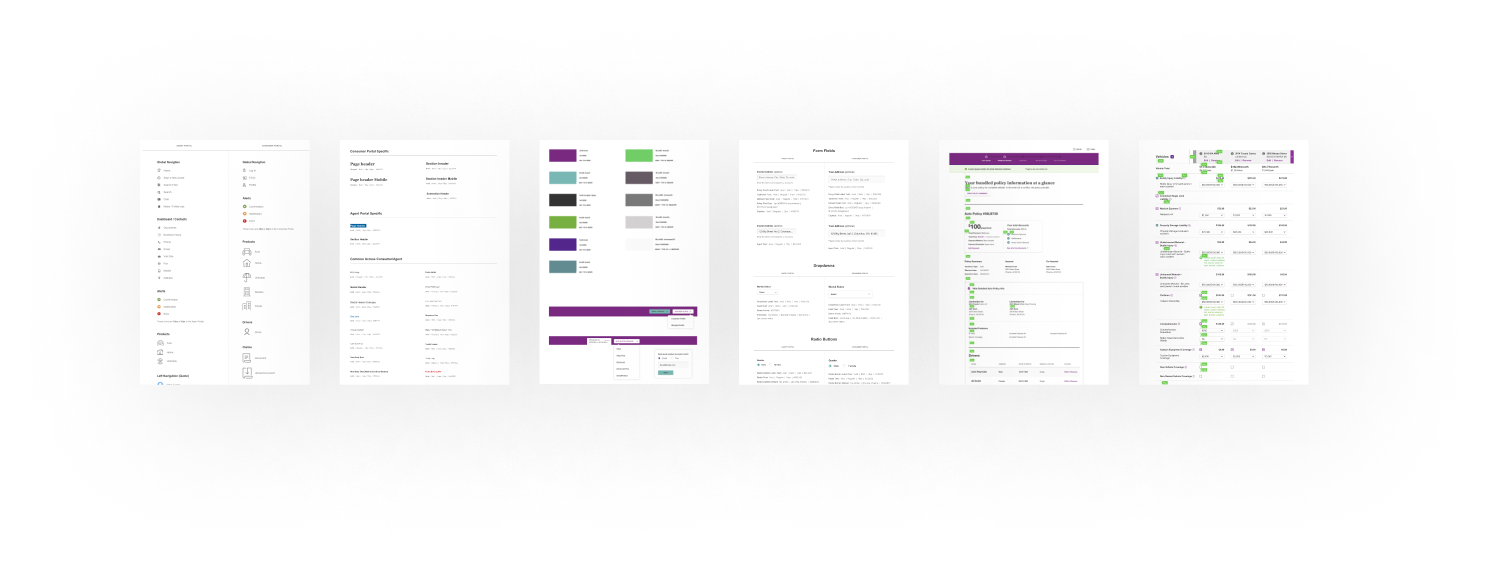
A scalable design system we created for a client—built as a modular, component-based foundation for implementation within the Guidewire platform.
While building a design system is relatively straightforward, making it usable, adoptable, and scalable across an enterprise is not.
In other words, everyone wants a design system, but not every organization is equipped to leverage one effectively. And without the right structures, teams, and priorities in place, even the most thoughtfully designed system will end up as shelfware: well-intentioned, well-documented, and largely unused.
What it takes to make design systems work in Insurance
To get a clearer answer on what it really takes to make a design system successful in insurance, I sat down with Cake & Arrow’s Director of UX, Michael Piastro, who has worked on dozens of insurance UX initiatives—from large digital transformations to enterprise-scale design system implementations.
He shared what separates design systems that become true enterprise assets from those that become shelfware.
This conversation has been adapted from an interview and edited for brevity and clarity.
Emily Cardineau: When you look across insurance organizations, what separates design systems that actually work from the ones that don’t?
Michael Piastro: Design systems succeed when organizations are structured to support them. They fail when they’re treated as a design deliverable instead of an enterprise initiative.
A lot of organizations come into this thinking the hardest part is building the design system. But building it is often the easiest step.
The real challenge is what happens afterward: whether teams adopt it, trust it, and use it as part of their everyday work. Without the right commitment, resources, and governance, even a well-designed system will become shelfware.
There are a few things insurance companies can do to ensure their design systems don’t just get built—but actually get used.
1. Prioritize the design system as an organizational initiative
Emily: Let’s start with prioritization. Why is leadership commitment such a big deal here?
Michael: Because adoption can’t be something that’s merely encouraged. It has to be an institutional priority.
If a design system is treated as a side initiative, it will quickly become shelfware. Teams are always under delivery pressure, and when deadlines hit, they default to one-off solutions and quick fixes. That’s exactly when consistency matters most, but it’s also when teams stop using anything that feels optional.
To succeed, the design system has to be treated as a core organizational capability. It directly impacts the quality, consistency, and speed of digital delivery, so it needs real commitment and accountability at a leadership level.
In some organizations, leadership comes from design. In others, it comes from engineering. In the best cases, it comes from both. The reporting line matters less than the outcome.
Someone needs the mandate to set standards and make sure they stick.
2. Staff and resource a team to maintain it
Emily: This is where we see organizations get surprised. They think “we built it” means “we’re done.” Why is resourcing so critical?
Michael: Because a design system is not a one-time build. It’s a living product, and it requires ongoing investment to stay relevant.
That includes documentation updates, component refinement, accessibility improvements, versioning, bug fixes, and hands-on support for the teams using it.
This is where many organizations underestimate the true cost. There is upfront effort required to build the foundation, but the real challenge is maintaining it over time. If the system isn’t resourced, it doesn’t stay useful.
The organizations that succeed invest in a dedicated design system team—usually a mix of designers and engineers—with real time allocated to maintaining and evolving the system.
If maintenance becomes a side project squeezed between product deadlines, the system degrades quickly. And eventually, companies end up back where they started: rebuilding components, creating new variants, and slowly drifting into inconsistency.
3. Drive adoption through advocacy and enablement
Emily: So even if the system exists and it’s well built, adoption still isn’t guaranteed. What actually drives teams to use it?
Michael: Adoption is not automatic. A well-built design system will still fail if teams don’t buy in.
Many insurance organizations fall into the “if we build it, they will come” trap. They assume that once the system exists, teams will naturally use it.
But teams adopt design systems when they can see the value immediately and understand how to apply it to their day-to-day work.
That’s why enablement is critical. Strong design systems are supported by active advocacy: clear onboarding, hands-on guidance, ongoing communication, and visible wins that show teams how the system makes their work easier.
Teams use the system because it helps them move faster and make better decisions—not because they’re required to.
If teams don’t see immediate value, the system quickly becomes another tool they’re expected to follow, and resistance grows fast.
4. Create a clear path for contribution and governance
Emily: What happens when a design system becomes too rigid, or too closed off?
Michael: If designers and developers don’t have a path to contribute ideas, propose improvements, or request new components, they will work around the system.
And once teams work around the system, inconsistency returns.
That’s how design systems quietly become shelfware. The library exists, but teams build outside of it because the system doesn’t evolve with real product needs.
Successful design systems establish a structured contribution model. There needs to be a clear process for intake, review, prioritization, and release. That allows the system to evolve while maintaining standards and preventing uncontrolled growth.
Without governance, the system becomes bloated. Without contribution, it becomes irrelevant.
You need both, and you need them from day one.
5. Build a design-to-code pipeline that scales across techstacks
Emily: This feels like the hardest part for insurance. What makes design-to-code especially complicated in this industry?
Michael: Personally, I’ve never worked with a carrier operating on one clean, modern stack.
They’re almost always supporting multiple tech stacks simultaneously: modern frameworks in some areas, legacy platforms in others, and vendor tools elsewhere. A design system can’t live solely in Figma. It has to connect to code in a way that enables teams across the organization to implement shared standards.
That requires design tokens, coded component libraries, version control, and a strategy for distributing the system across different environments.
Over time, AI may help automate parts of that pipeline. But even as automation improves, the foundation still matters: standardization, governance, and a system designed to scale across complexity.
If the design-to-code pipeline isn’t clear, design systems become documentation instead of an operational asset.
The bottom line: Design systems are a strategy, not a deliverable
Insurance companies are wise to invest in design systems. Customer expectations are rising, competition is increasing, and experience quality is becoming a real differentiator.
But the value of a design system isn’t in the initial build—it’s in what it enables over time. When treated as a long-term institutional capability, design systems support faster delivery, greater consistency, and scalable digital modernization.
There are real investments required to make that happen, and they aren’t always easy in complex insurance environments. But if you look at organizations delivering cohesive digital experiences at scale, you’ll almost always find a design system behind their success—built not just to launch, but to last.