Over the past year, we spent hundreds of hours talking with agents, brokers, underwriters, benefits administrators, and customers across the insurance ecosystem. We sat with people inside underwriting platforms, billing portals, enrollment flows, and internal tools, watching how work actually gets done, where systems support it, and where people are forced to compensate.
Across organizations, roles, and workflows, the same patterns emerged—foundational truths that speak to how people experience insurance systems in moments that matter: when a customer is waiting for a quote, when a question needs an immediate answer, or when a contract needs to be signed.
In a highly regulated industry shaped by legacy technology, fragmented ownership, and layered relationships, good UX isn’t just about polish. It’s about designing systems that reflect how people really work, how they coordinate, communicate, and make judgment calls under pressure. The lessons below reflect what we now know after a year of research and design work in insurance.
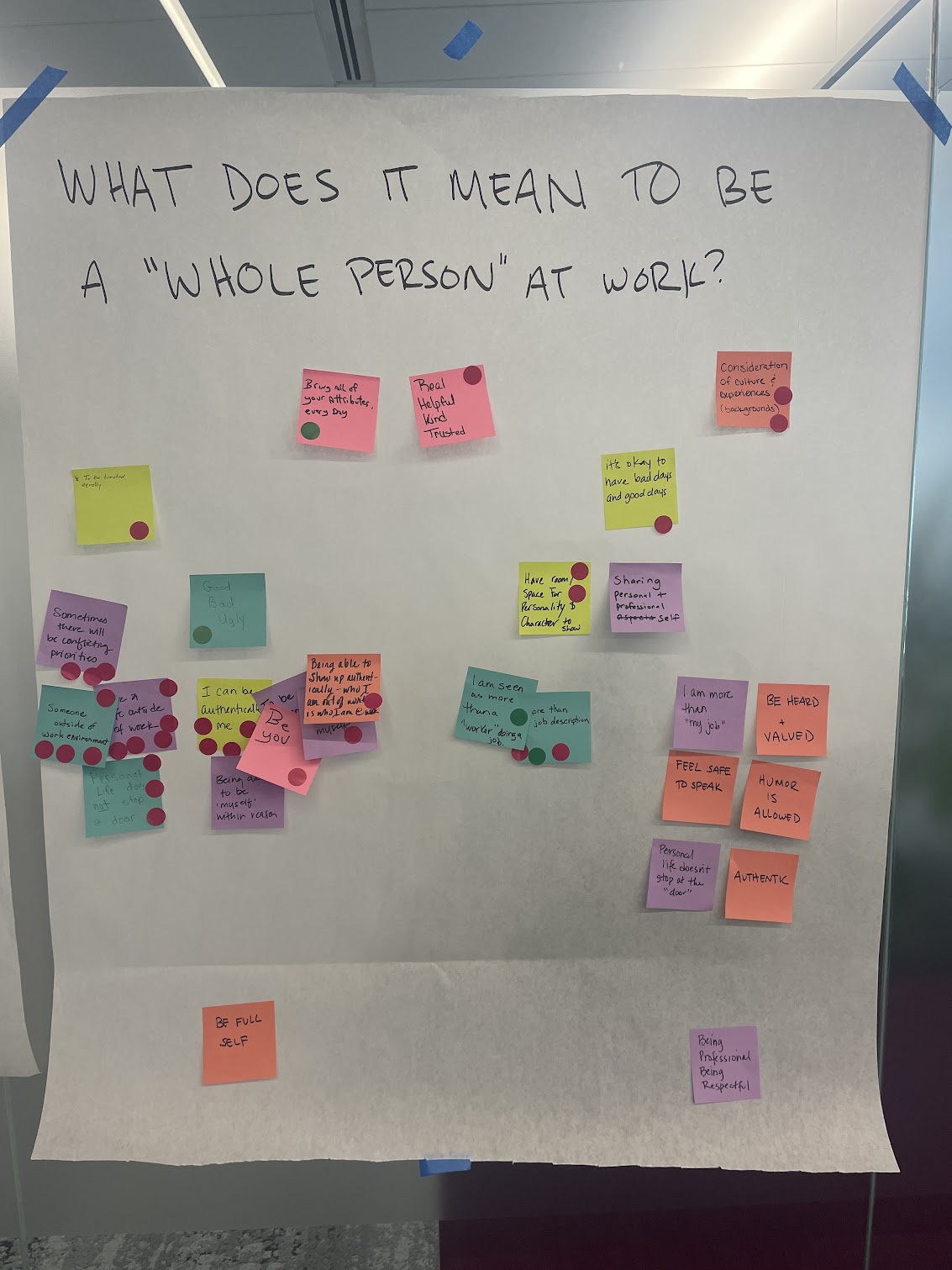
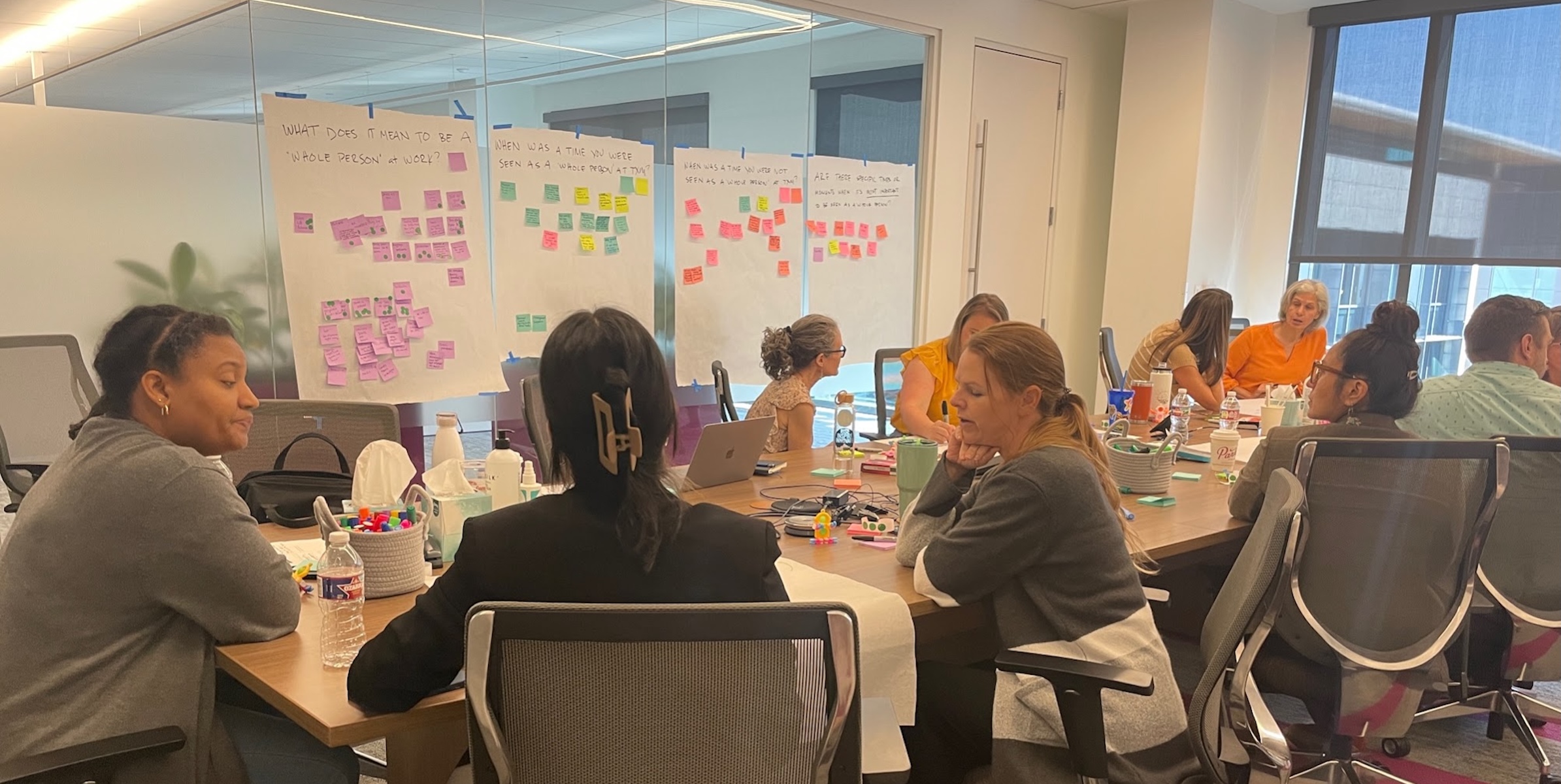
From a client workshop exploring what it means to support people as whole humans at work, and how that perspective informs the design of internal systems.
1. Modern systems should streamline work, not just relocate it
In the age of AI, you’d expect most organizations to be well past digitizing business as usual. But in practice, many insurance systems still move existing workflows into new portals or interfaces without changing the underlying work, and call that modernization. When people are still entering the same data, running the same checks, and managing the same exceptions, the experience doesn’t feel easier or more efficient.
In qualitative research with HR benefits managers, participants told us plainly, “I don’t know that it’s really saving me that much work. Because I’m still having to enter everything.” Another noted that the only step eliminated was emailing a spreadsheet—“and that takes like two seconds.” What users consistently described as progress wasn’t new technology, but fewer steps.
Where systems earned trust was when they genuinely reduced effort—through pre-filled information, smarter sorting, or clearer visibility into progress. But when digitized systems made decisions feel final, opaque, or impossible to question, confidence dropped quickly. Especially among younger participants, systems that denied coverage or claims without explanation or human follow-up reinforced a broader sense of institutional distrust. For users, modernization means doing less work with more clarity, not just doing the same work on a different screen or platform.
2. Self-service works only when help is within reach
Self-service is often framed as removing people from the process. But our research shows that independence only works when users know support is there if they need it. People want to move at their own pace—but not at the cost of feeling abandoned once something becomes unclear, risky, or high-stakes.
Across enrollment and application experiences, participants repeatedly asked what would happen if they got stuck. One user noted that while the process itself felt straightforward, “I didn’t see any reference to if there was any way to speak to someone along the way.” Another said they would want “the ability to chat with someone… or like a phone number to call to ask questions.”
Even when users didn’t expect to use these options, knowing they existed changed how safe the experience felt. When support was hidden or missing, hesitation increased. When help was visible, people felt confident enough to proceed on their own. Successful self-service doesn’t eliminate human support. It makes it easy to reach when it matters.
3. Transparency, not assurance, gives rise to trust
People don’t need brands to promise ease or savings. They want to know what will happen, how long it will take, what information is required, and where they might get blocked.
In application and enrollment research, participants consistently emphasized the value of upfront clarity. One person noted that “knowing that it takes 15 minutes… is actually important to me,” because it helped them decide whether to start at all. Others expressed frustration when exclusions or disqualifications surfaced late, saying they would rather have known early than invested time in something that wasn’t going to work.
What builds trust isn’t reassurance, it’s specificity. Clear time estimates, early disclosure of constraints, and visible requirements make systems feel honest and predictable. Even when the answer is “no,” people prefer transparent boundaries upfront to vague assurances that only unravel later.
4. When systems don’t connect, complexity multiplies
Fragmented systems don’t just slow people down, they force them to invent new ways of getting work done. When tools don’t connect, and information doesn’t flow, users compensate with manual processes, parallel tracking, and informal handoffs. Over time, these workarounds become an added layer of complexity that the system was meant to remove. This is a reality that anyone designing insurance systems has to account for.
Across internal and external-facing workflows, participants described this fragmentation as a daily tax. One underwriter said, “I feel like here there’s so much information, but it’s scattered all over the place.” Another added, “We can literally think of six different ways we currently use to communicate information about one policy or quote, which is a little crazy.”
The temporary hacks people invent to just keep things moving, good or bad, soon become normalized behaviors, and often informal parts of an ever-complex process. Fragmentation doesn’t stay contained. It compounds.
5. People don’t want every option — they want the right ones
We know that usability fails not when systems are underpowered, but when they are overexposed. When every option, state, and feature is surfaced at once, users are left to do the work of prioritization themselves.
In internal workflow research, underwriters were clear about what mattered most. One said, “I want to be able to sort for urgency and opportunities.” Another emphasized that quotes were the priority because “that’s how we’re going to continue to grow.” These weren’t requests for more functionality—they were requests for better prioritization.
The most usable systems make intentional choices about what to surface, what to defer, what to hide, and what to build in the first place. By prioritizing what directly supports decisions and outcomes, systems feel simpler, faster, and easier to trust—even in complex environments.
6. People trust a clear “no” more than a slow “maybe”
Uncertainty quietly erodes confidence. Across our research, users consistently preferred early, definitive signals over prolonged ambiguity—even when the answer wasn’t favorable.
In application and intake workflows, participants said they wanted to know as early as possible whether something was viable. One broker explained, “I’d like to know that before I get to this point… I kind of wasted my time.” Another praised systems that disqualified early, saying, “It kicks you out as soon as you answer questions… I’d rather that than waste my time.”
Clear boundaries respect people’s time. Prolonged uncertainty wastes it.
7. Clarity is more important than speed
In complex, high-stakes systems, people are constantly scanning for signals: Did this go through? Who has it now? Do I need to do something else? Trust forms when those answers are visible and predictable.
When systems go quiet, users don’t interpret silence as progress; they interpret it as risk. Benefits administrators described checking back every 12–24 hours after submitting information, not out of impatience, but because there was no clear signal that anything was actually happening. Underwriters described referral processes that felt like a black box, where sending something off meant losing visibility entirely.
Across enrollment, billing, and underwriting workflows, the pattern is consistent: clear confirmation, visible status, and “what happens next” cues matter more than fast processing alone. When people can see where things stand, they trust the system to do its job, and they can get back to doing theirs.
At the end of the day, insurance is a people business
After a year of research across underwriting, billing, enrollment, claims, and servicing, one thing is unmistakable: insurance may be built on policies, rules, and risk models, but it’s sustained by people.
Every workflow we studied ultimately depended on human judgment, coordination, follow-through, and trust. The systems meant to support that work can either make it easier or quietly get in the way. When tools are opaque, fragmented, or overly complex, people compensate by double-checking, inventing workarounds, and carrying risk in their heads. When systems are clear, predictable, and well-scoped, people can focus on what actually matters.
This is why modernization in insurance can’t stop at digitization. Moving work into a portal doesn’t automatically make it easier. Automating decisions doesn’t automatically build trust. Real progress comes from designing insurance systems that reduce unnecessary effort, make collaboration visible, and support—not replace—human judgment.
At its core, insurance is a collaborative business. It relies on clear communication between teams, confidence between customers and carriers, and shared understanding across complex handoffs. All system design is ultimately in the service of that reality. When tools are designed around real roles, real pressures, and real moments of need, they don’t just function better; they give people back time, clarity, and confidence.
That’s what this year reinforced for our team. And that’s the standard we’ll keep holding as we continue designing systems for an industry built on people trusting one another to do the right thing.
Related Articles


by Emily Smith Cardineau